The U.S. solar industry is growing fast. Installations passed 40 GWdc in 2024, and utility-scale projects now supply power to millions of homes nationwide. More developers, EPCs, and distributors want stable suppliers inside the country, especially as domestic content rules and IRA incentives continue to shape purchasing decisions. In this environment, Solar Panel Manufacturers In The USA have become a key focus for anyone planning new residential, commercial, or utility projects.
Buyers face several challenges. Tariffs on imported panels, AD/CVD investigations, and UFLPA compliance make sourcing more complex. Prices change quickly because of global supply-chain shifts. Many companies also struggle to confirm which products qualify for IRA domestic content credits. These problems lead to delays, unexpected costs, and uncertainty during project planning.
This guide gives a clear overview of the top 10 U.S. solar panel manufacturers in 2025. You will see each company’s production capacity, technology strengths, factory locations, and domestic-content advantages. The goal is to help project developers, installers, and distributors choose reliable partners and make smarter purchasing decisions.
First Solar
First Solar takes a different path from other manufacturers on this list. The company uses cadmium telluride (CdTe) thin-film technology . This makes First Solar the single major solar company that doesn’t use traditional crystalline silicon panels. The company started in 1999 in Tempe, Arizona. Today, it’s America’s top domestic solar technology provider and the world’s largest CdTe module maker.
CdTe Thin-Film Technology
First Solar’s CdTe modules work differently than standard mono PERC or TOPCon panels. They use a glass substrate deposition process. This allows for automated, large-format panel production. You get several key benefits for utility-scale projects:
Better performance in hot weather : Lower temperature coefficients create higher energy output in hot climates like Texas, Arizona, and California
Stronger output in low light : Great spectral response when it’s cloudy or humid
Slower performance decline : Far less PID (Potential Induced Degradation) and LID (Light Induced Degradation) compared to silicon panels
Independent supply chain : No dependence on polysilicon markets, protecting projects from silicon price swings
Real-world data shows First Solar panels produce more kWh/kWp output than similar-wattage crystalline modules in high-sun areas. This matters for getting the best ROI on large ground-mount setups.
Large U.S. Manufacturing Network
First Solar runs the biggest American solar manufacturing network . The company has five facilities, all in the United States:
Ohio (Perrysburg/Lake Township) : Multiple Series 6 and Series 7 production lines. This is the company’s original manufacturing base.
Alabama (Lawrence County) : New facility meeting IRA domestic content rules
Louisiana (Iberia Parish) : Newest Series 7 factory serving Gulf Coast and Southeast projects
The company plans to reach 10+ GW of U.S. production capacity by 2026 . This will make First Solar the domestic solar manufacturer with the highest output. R&D labs in California and Ohio keep improving CdTe efficiency. Recent Series 7 modules now match competitive conversion rates while keeping thin-film’s natural cost benefits.
Qcells (Hanwha Qcells)
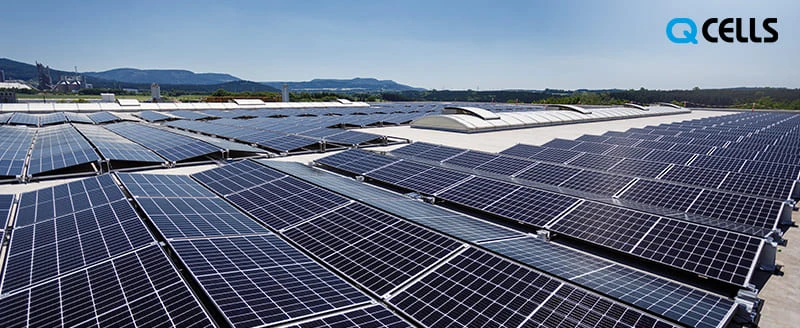
Hanwha Qcells runs the largest solar panel production network in North America . Their two Georgia facilities in Dalton and Cartersville produce 8.4 GW of modules each year . This South Korean-owned maker bought the original German Q-Cells brand in 2012. They’re now the sole North American company making the full solar chain—from silicon ingots to finished modules—across U.S. and Korean sites.
Complete U.S. Manufacturing Integration
Qcells’ Georgia plants handle both cell and module production on American soil. The Dalton and Cartersville sites make “Made in America” modules that qualify for IRA domestic content credits . Commercial installers and utility developers need these to meet Buy America rules for federal projects.
The company brings in some early-stage materials like polysilicon and wafers. But the key steps—cell processing and module assembly—happen in Georgia. This mix keeps prices competitive. Plus, you still get domestic manufacturing perks.
Q.PEAK DUO Performance Profile
The Q.PEAK DUO series uses monocrystalline PERC bifacial technology . You get 400-450W per module. Conversion efficiency sits between 20.5-21.5% . The bifacial design grabs reflected light from the ground. This adds 10-15% extra energy in the right setup.
Temperature performance holds strong with a -0.30%/°C coefficient . These modules excel in hot spots like Arizona and Texas. The IP68-rated junction box and rust-proof aluminum frame stand up to tough coastal and desert conditions.
Qcells backs modules with a 12-15 year product warranty and linear performance promise. Expect 97-98% output in year one . Output drops about 0.45-0.55% each year to 80-85% at year 25-30. Hanwha Solutions’ solid finances back these long-term promises. This matters for commercial project funding.
S&P Global named Qcells a 2025 Tier 1 Cleantech Company . They scored high in financial strength, green practices, and brand trust.
Canadian Solar
Canadian Solar (NASDAQ: CSIQ) ranks #4 among solar module makers in 2025 . The company ships modules to over 160 countries with 165 GW of total deliveries . Dr. Shawn Qu started the business in 2001 in Ontario, Canada. Today the company brings in $5.6-6.3 billion in annual revenue . Operations cover manufacturing, energy storage, and utility-scale project development.
Aggressive U.S. Manufacturing Expansion
Canadian Solar operates three major American production sites . These meet domestic content requirements:
Mesquite, Texas : 5 GW module plant running since late 2023
Jeffersonville, Indiana : Solar cell factory starting production March 2026 (Phase I)
Texas battery storage facility : BESS manufacturing launching second half of 2026
The company restructured U.S. operations in December 2025. It created CS PowerTech as a majority-owned joint venture (75.1% stake) . This new entity controls all American manufacturing. It also handles sales of panels, cells, and storage systems. The move puts operations under direct North American management. No more oversight from the China-listed CSI Solar subsidiary.
TOPCon and HJT Technology Leadership
Canadian Solar builds high-efficiency modules. They use TOPCon and HJT cell designs . The flagship TOPBiHiKu7 series delivers up to 730W output with 24.4% conversion efficiency . Bifaciality reaches 95% . This pulls maximum energy from reflected ground light.
HJT modules like the HiHero+ series blend crystalline silicon with thin-film layers. You get lower temperature coefficients . Performance stays stronger in heat. The company holds over 2,200 patents . These cover cell design, low-carbon manufacturing, and storage solutions.
BloombergNEF rated Canadian Solar modules 100% bankable in its latest 2022 survey. That’s crucial for project financing approval.
Illuminate USA (LONGi Solar)
LONGi Solar now makes panels in the U.S. through Illuminate USA . Invenergy owns 51% of the company. LONGi Green Energy Technology holds the other 49%. Jim Murphy leads Invenergy as president. He also chairs Illuminate USA’s board. They announced the Ohio factory in March 2023. Operations started in 2024.
Ohio’s Largest Solar Manufacturing Plant
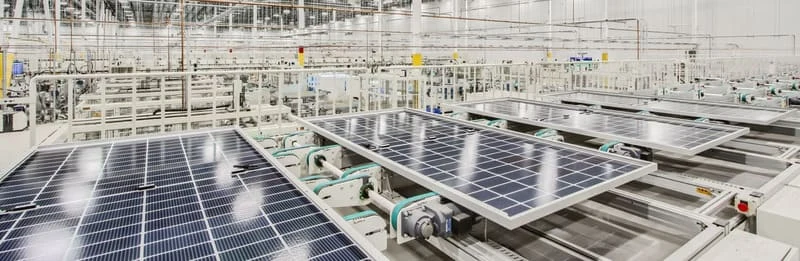
The Pataskala facility covers 1.1 million square feet at 3600 Etna Parkway. Eight production lines create 5 GW of capacity each year . That’s enough to make over 9.2 million solar modules. This output could power one million American homes .
Licking County got more than $600 million in total investment . This money pays for equipment, raw materials, training, and operations. The project secured $4 million in state incentives . Local government also gave a 15-year property tax break. Federal support adds more: Illuminate USA gets around $350 million per year in IRA tax credits .
Bifacial Technology for Dual Markets
The factory makes bifacial solar modules using LONGi’s techniques. These panels have two sides that capture light. They collect reflected light from the ground. This boosts energy output by 10-20% in the right setup.
Illuminate USA targets two markets:
Utility-scale projects : Large solar farms that need megawatt-level power
Rooftop/residential systems : Solar panels for homes and commercial buildings
Invenergy is the anchor customer . They buy large volumes of modules for renewable energy projects across North America. This steady demand keeps production stable. It also proves the quality of U.S.-made products to other buyers.
T1 Energy (Trina Solar)
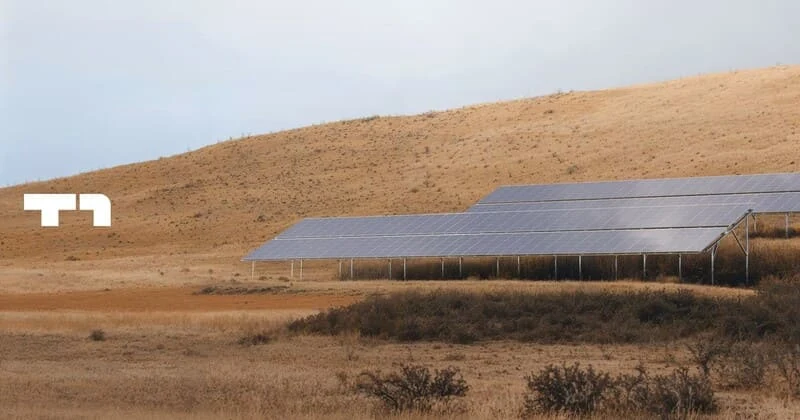
T1 Energy owns America’s newest large-scale solar factory. The company made a big industry shift. They bought all of Trina Solar’s U.S. manufacturing assets in late 2024 for $340 million . The deal brought them a 5 GW module factory in Wilmer, Texas . This is one of the largest automated solar plants in North America. T1 Energy used to be Freyr Battery. They canceled a $2.6 billion battery storage project in Georgia. Then they switched all focus to solar module and cell production.
Texas-Based Production Network
T1 Energy runs two major facilities in Texas:
G1 Dallas (Wilmer) : This 1.35 million square-foot module factory made 443 MW in Q1 2025 . It can produce 5 GW per year. Right now, the company is updating production lines. They’re switching from older PERC technology to n-type TOPCon cells . This upgrade cut 2025 output goals to 2.6-3.0 GW for now. T1 already has 1.7 GW of contracted module sales locked in for 2025.
G2 Austin (Milam County) : This $850 million solar cell factory will start making panels in second half 2026 . You’ll see 5 GW of TOPCon cells coming out each year. The facility brings 1,800 full-time jobs to the area. Milam County gave long-term tax breaks to back the project.
TOPCon Technology Integration
T1’s modules use n-type TOPCon cell design . This comes from Trina Solar’s tech platform. Key specs hit up to 23.2% efficiency . The bifacial designs catch reflected light too. These panels deliver the same performance as Trina’s proven Vertex series. Plus, they meet IRA domestic content requirements . This makes them eligible for federal projects.

Silfab Solar
Silfab Solar brings over 40 years of solar manufacturing expertise to North America. We focus on high-efficiency modules for homes and businesses across the United States and Canada. Our reputation comes from consistent quality and local production that helps regional economies.
Dual-Facility U.S. Manufacturing Strategy
We run two American factories that form a complete solar production chain :
Burlington, Washington : Our first factory makes 800 MW of modules each year on automated lines. A 1.4 MW rooftop solar array powers part of the site. This cuts the carbon footprint of every panel we make here.
Fort Mill, South Carolina : This $268 million expansion opened mid-2025. The facility produces 1 GW of N-type solar cells plus 1.2-1.3 GW of modules per year. We created 800 skilled jobs in the area. On-site systems handle wastewater treatment and waste recycling to reduce environmental impact.
Combined, both plants make over 2 GW per year . They meet FEOC (Foreign Entity of Concern) compliance . Your modules qualify for full IRA domestic content credits on federal projects.
N-Type TOPCon Technology Leadership
Our modules use advanced N-type TOPCon (NTC) cells . Efficiency reaches up to 25.7% . That’s over 2 percentage points higher than traditional P-type cells. Electrons move faster, so you get more power from the same sunlight.
This tech works great in North American climates:
Better temperature performance : Less power loss in summer heat versus standard panels
Strong low-light output : Generates electricity on cloudy days and at dawn/dusk
Slower degradation : Less than 0.5% annual decline versus 0.7-1.0% for older designs
The Silfab Prime NTC comes in all-black with anodized frames. Each module delivers 440W . Commercial versions reach up to 640W . White backsheets keep cells cooler. Anti-reflective glass grabs more light.
Kiwa PVEL named us a Top Performer for seven straight years (through 2025). We keep one of the industry’s lowest defect rates and a 95% customer satisfaction score . We recently signed a 350 MW deal with Pivot Energy for community solar projects.
Jinko Solar
JinkoSolar (NYSE: JKS) shipped 61.9 GW of modules worldwide in the first three quarters of 2025 . That makes them the world’s #1 solar maker by volume. The company started in 2006 in Shangrao, China. They went public on the New York Stock Exchange in 2010. Now they run factories across Asia, Europe, and the United States.
Jacksonville Manufacturing Hub
JinkoSolar runs a silicon module factory in Jacksonville, Florida . The plant opened in 2018. It was the first big Chinese solar factory on American soil. The site builds modules from imported cells. Current output sits at up to 1 GW per year after recent expansions.
The Jacksonville plant makes single-sided and double-sided silicon modules . Power ratings range from 400W to 580W based on size. These modules meet UL 61730 and IEC 61215/61730 standards for North American markets. They qualify for local content rules on some federal and utility projects.
Tiger Neo N-Type Technology
JinkoSolar’s top Tiger Neo series uses n-type TOPCon cells . Module power tops 22% on best models. Home 60/66-cell formats give 390-440W . Big 72/78-cell panels hit 540-620W .
Double-sided designs catch reflected ground light. You get 5-25% extra energy in the right setup. Split-cell design and multiple wire paths cut power loss. BloombergNEF ranks JinkoSolar as a Tier 1 maker for financing. The company has an MSCI ESG rating of “A” —the best among major solar makers.
Mission Solar
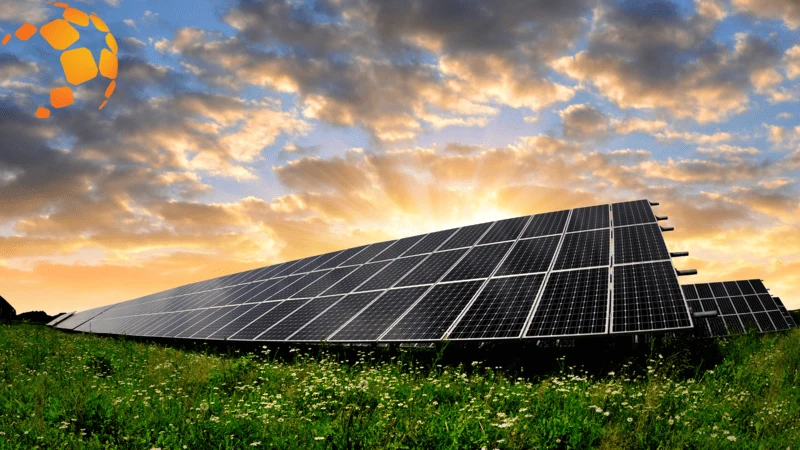
OCI Holdings built this facility in San Antonio, Texas back in 2014 . Mission Solar Energy has spent over ten years making solar panels for homes and businesses across America. The company runs one U.S. factory that puts together complete solar modules using monocrystalline cells.
Texas Manufacturing and Clean Supply Chain
The San Antonio factory makes about 1 GW of modules each year . You’ll find all design and production work at 8303 S. New Braunfels Ave. Mission Solar connects directly to parent company OCI’s supply chain. The polysilicon comes from OCI’s Malaysian plant, which uses hydroelectric power instead of coal . This cuts down the carbon footprint of raw materials.
Mission Solar follows UFLPA (Uyghur Forced Labor Prevention Act) rules for new products. Their modules skip AD/CVD tariff problems. Sister companies nearby include OCI Energy for utility projects and Sun Action Trackers for mounting systems. Having these companies close by means faster project completion across Texas.
Product Range from Rooftop to Utility Scale
The MSE435 series puts out 435W through 108 half-cut monocrystalline cells. Power tolerance runs positive at 0 to +5W . These modules work great for homes and small commercial rooftops.
Bigger projects use TOPCon bifacial dual-glass modules . You get 144 half-cut n-type cells with SMBB multi-busbar design . The bifacial design catches reflected light from the ground. This makes them perfect for utility-scale and C&I setups. Mission Solar started with residential panels but now serves commercial and utility builders who want American-made products.
Meyer Burger
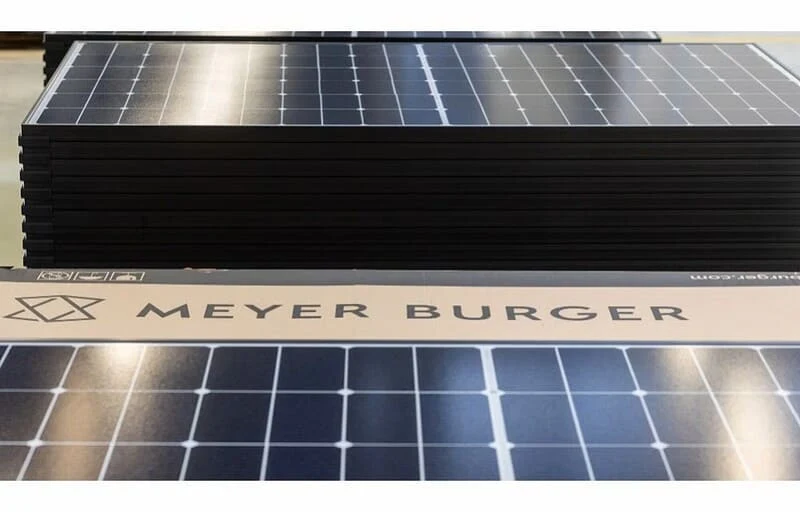
Meyer Burger Technology AG brought Swiss precision engineering to American solar making before market pressures forced a 2025 restructuring. The company has spent over 40 years building equipment for solar panel production. They created Heterojunction/SmartWire Connection Technology (HJT/SWCT®) . This tech pairs special solar cells with advanced wire connections. You get more energy per square foot than standard panels deliver.
Arizona Factory and IRA Strategy
Meyer Burger planned a 2 GW HJT module factory in Goodyear, Arizona . The facility was for utility and commercial buyers. It aimed to capture IRA domestic content tax credits and skip import tariffs. Local government gave tax breaks and infrastructure help to bring advanced solar making to the Southwest.
The company filed Chapter 11 bankruptcy for U.S. operations in 2025. German subsidiaries filed insolvency too. The Swiss parent company still runs. This shift stopped American production plans before full-scale making could start.
Premium HJT Product Line
Meyer Burger made three module types before closing U.S. facilities:
Meyer Burger Black : All-black home panels with 375-395W output and 21.8% efficiency . Weighs just 19.7 kg. Performs well in low light
Meyer Burger White : White backsheet design hits 22.2% efficiency and 400W . Cools better in hot climates
Meyer Burger Glass : Two-sided glass build gives 370-390W with 30-year warranties . Resists cracks better for ground-mount systems
KIWA PVEL named Meyer Burger a Top Performer in all seven quality tests in 2025 . Less than 6% of tested models get this rating.
Heliene
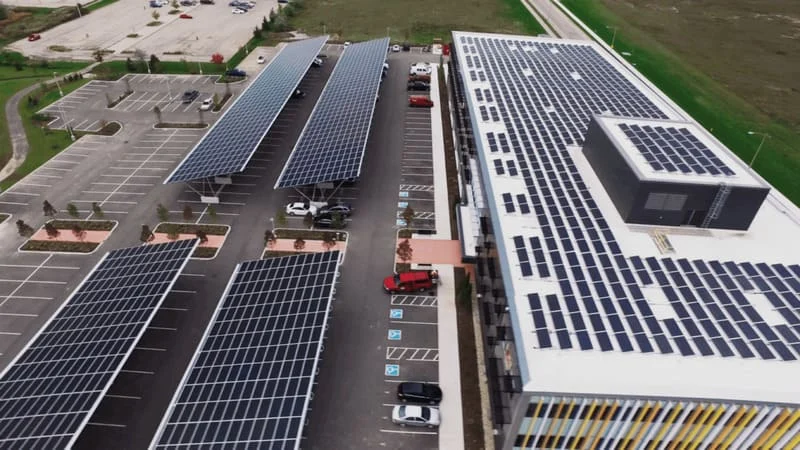
Heliene Inc. makes solar panels across North America. The company has 1.5 GW of total U.S. capacity . This Canadian company serves homes, businesses, and community solar markets. They run two Minnesota facilities. Their focus? High domestic-content modules that meet IRA requirements. Automated systems keep quality steady on every production line.
Minnesota’s Expanding Production Base
Heliene runs facilities in Mountain Iron and Rogers, Minnesota :
Mountain Iron : They expanded by 500 MW in 2023 . Two more 300 MW lines bring the site to 1.5 GW for modules. The company plans 1 GW cell production starting in 2025.
Rogers (Minneapolis area) : This new factory adds 550 MW of module capacity . That’s enough power for about 95,000 American homes each year.
Minnesota output hits 1.3-1.5 GW each year . Robots handle cell string placement. They also run inspection. Less human contact means fewer defects. Quick delivery systems cut storage costs.
High Domestic Content Through Strategic Partnerships
Heliene gets up to 66% domestic content in finished modules. They partner with Suniva for cells. Corning supplies components. This keeps the chain in America. Their bifacial crystalline modules hit 20-23% efficiency . EnergySage gives them “Very Good” marks for real-world use.
The company locked in a 1.5 GW deal with Nexamp . These modules power community solar projects. Minnesota plants will ship all units over five years. Excelsior Energy Capital buys Heliene products for commercial jobs. So do other developers. Heliene grabbed Gold in Business Technology at the 2025 Merit Awards.
Choosing the right partner from these Solar Panel Manufacturers In The USA helps buyers avoid tariff risks, shipping delays, and supply-chain uncertainty. Each company in this guide offers different strengths, from thin-film technology to high-efficiency TOPCon and HJT modules. Your final choice should match project size, budget, and domestic-content needs. U.S. factories continue to grow fast, giving EPCs, installers, and distributors more stable options than before. For more support on solar sourcing, product comparisons, or OEM solutions, feel free to reach out and explore the next steps for your project.