Security cameras with solar panels are quickly becoming one of the most popular choices for modern home and outdoor surveillance. As energy costs rise and property owners seek easier installations, solar-powered security cameras offer a smart solution—combining renewable power with wireless freedom. No wiring, no constant charging, and no reliance on the electrical grid. These cameras draw energy directly from sunlight, storing it in built-in batteries for continuous 24-hour monitoring.
Their popularity continues to grow in both residential and remote applications—from home driveways to farm entrances—because they solve one of the biggest challenges in security: reliable power in off-grid areas. In this article, you’ll learn how security cameras with solar panels actually work, what limitations they have, and how they perform in real conditions. We’ll cover everything from WiFi requirements and night performance to charging times, lifespan, and how they handle power outages. By the end, you’ll have a clear understanding of whether solar-powered security cameras are the right fit for your needs.

Do Security Cameras With Solar Panels Work?
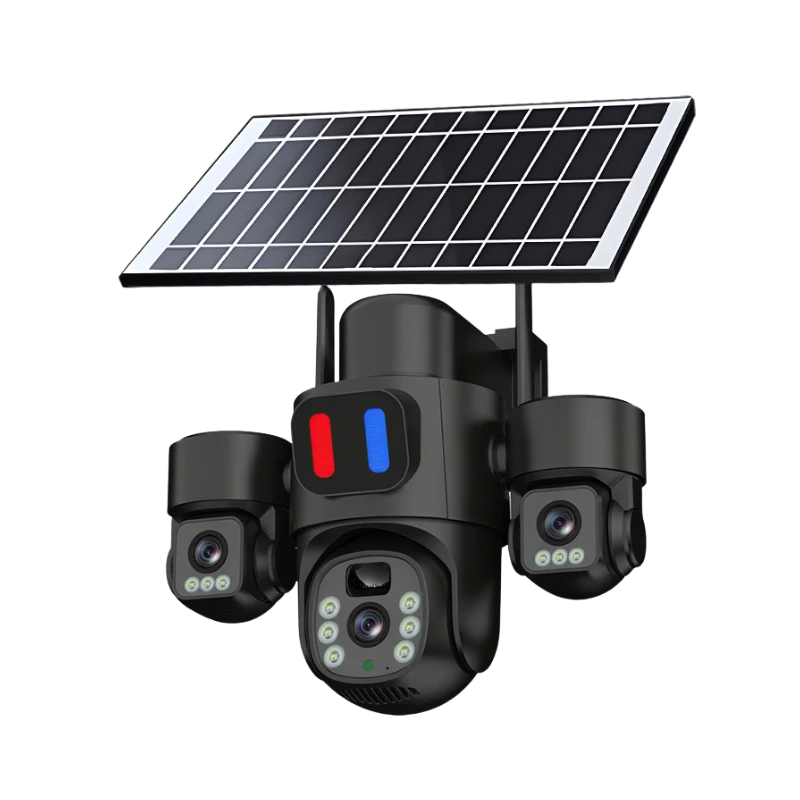
Solar panel security cameras do work, they perform well in off-grid and wireless setups. Traditional wiring isn’t possible in many locations. These cameras recharge their batteries using sunlight. The solar panels can be attached or built-in. You don’t need to plug them into an electrical outlet.
How Solar Security Cameras Operate
- Solar panels provide constant energy to the camera’s battery.
- The panel needs 4-6 hours of full sun per day. This keeps the camera charged for 24-hour use.
- Most models include HD video, motion detection, night vision, and mobile app access.
Ideal Placement for Maximum Performance
For maximum performance, I recommend you place solar panel cameras carefully:
- Install panels facing south (in the Northern Hemisphere). This captures maximum sunlight.
- Avoid shaded areas, north-facing spots, or thick wooded zones. These reduce charging power.
- East- or west-facing panels may not perform well if direct sunlight is limited.
Real-World Results and User Experiences
Independent tests show reliable performance from brands like Ring, Eufy, ADT, and Lorex.
Motion detection rates reach 70-80% accuracy for most home needs.
Limitations and Best Use Cases
Shaded or bad-angled panels may not charge enough. This impacts reliability.
Solar camera systems work best for moderate security needs. Think home driveways, barns, gates, or sheds in sunny areas.
What Are the Disadvantages of Solar Cameras: Key Limitations Before You Buy
Solar security cameras offer wire-free installation and green operation. But before you buy, it is wise to understand their downsides first. Many user reports and expert reviews point out several issues you might need to know:
Weather Dependency and Battery Drain
Solar cameras need direct sunlight for charging. Cloudy, rainy, or overcast days cut panel power.
Cameras in areas with long stretches of poor weather (like the Pacific Northwest), the battery drains after just 2–3 days without sun.
Some models have larger batteries or hybrid charging. But weather still limits performance.
Upfront Cost Considerations
Initial prices for solar-powered cameras range from $100–$300 per camera—including the solar panel. This costs more than entry-level wired systems. The gap widens if you need to cover multiple areas. Over time, you may recover part of the cost through electricity savings. But the starting budget matters.
Ongoing Maintenance Requirements
Rechargeable batteries last 1–3 years (around 500 cycles) before you need to replace them.
Dirty panels—from dust, leaves, or bird droppings—cut charging power. You must clean them often.
I suggest you choose models with easy-access, user-replaceable batteries and panels. This saves hassle over time.
Wireless Signal Fluctuations
Wi-Fi can be weak or unreliable in remote areas. This causes laggy video or missed motion alerts. On large properties or where Wi-Fi is unstable, I recommend cellular solar security camera models. They add to the total cost, though.
Feature and Scalability Limits
Some solar camera systems lack advanced features. High-end wired models offer ultra-high resolution (4K), AI analytics, or extensive storage options. Many solar cameras don’t.
Expanding your system with multiple solar cameras adds complexity. This is true for advanced setups.
Inconsistent Night and Extended Monitoring
Continuous recording at night or frequent motion-triggered events drain camera batteries faster. This happens if solar charging is low.
Based on my experience, solar security cameras work best for motion-activated monitoring. They don’t handle full 24/7 recording well.
The above drawbacks make solar-powered security cameras less suitable for high-security needs. They also struggle in locations with persistent overcast conditions. In such cases, I suggest wired security systems for more consistent and solid performance.
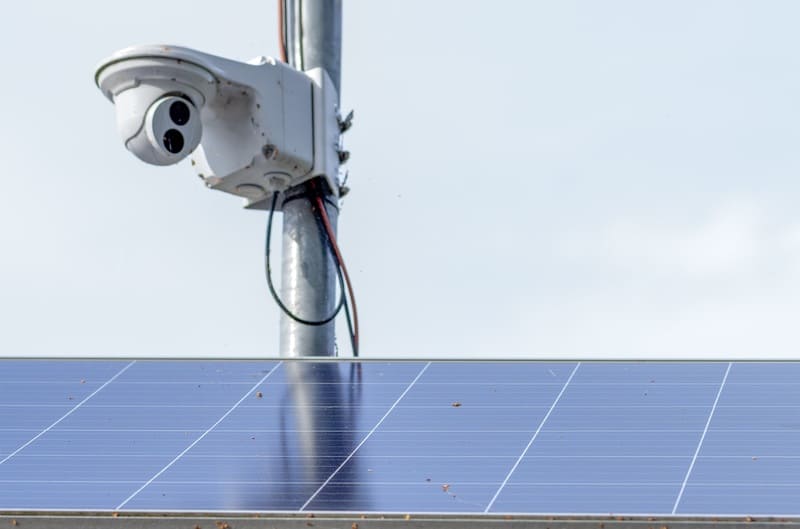
Do Solar Panel Security Cameras Need WiFi?
No, solar panel cameras do not strictly need WiFi, though many popular models rely on it for remote viewing, app notifications, and cloud storage. WiFi-dependent systems (e.g., Ring or Eufy) connect to your home network for live feeds and alerts, but this limits them to areas with strong signal coverage.
WiFi-Free Operation and Off-Grid Options
WiFi is not always necessary for solar security cameras. I recommend several alternatives for remote or off-grid areas:
- Cellular (4G/LTE) Solar Cameras: These cameras have built-in SIM cards. They connect through mobile networks, not home internet. I suggest models like the Reolink Go or Eufy 4G solar cameras. They cost around $150 to $250, plus a data plan (about $10 per month). They send alerts and stream video using cellular data. I find them perfect for driveways, gates, barns, and other hard-to-wire spots.
- Local Storage Options: Some cameras (like select Arlo or Wyze models) record to microSD cards. You access the footage on-site. No network needed. Based on my experience, this setup works well for rural properties, construction sites, or outbuildings. It’s ideal for places with limited connectivity.
- Hybrid and Local Hotspot Setups: You can pair your camera with a portable hotspot. Solar-powered routers are available for total off-grid installs. You can even use Bluetooth for short-range connections. This gives you some access without broad WiFi.
Choosing the Right Connection for Your Needs
Do you need remote live viewing and instant notifications? If not, I recommend a no-WiFi solar camera. It gives you true wireless freedom. But for most homeowners, WiFi makes life easier. It simplifies use, smart alerts, and system management. It adds more flexibility too.
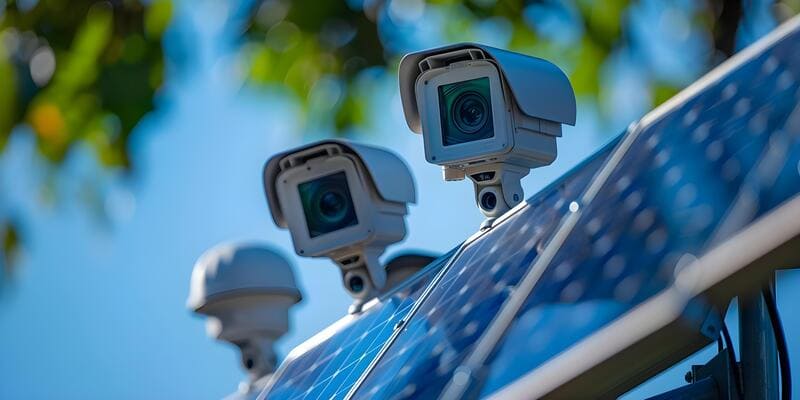
Do Solar Panel Cameras Work at Night? Real Night Performance, Battery Usage, and Top Brands
Yes, solar panel cameras work reliably at night, drawing from batteries charged during the day rather than direct solar power.
Most models come with infrared (IR) night vision. You can see black-and-white images up to 30–50 feet in pitch darkness.
Some cameras offer color night vision. They use built-in LED spotlights. This is useful, but I suggest limiting spotlight use. Frequent use drains the battery faster than IR alone.
How Long Do Solar Security Cameras Last Overnight?
On a full charge, stored battery power supports 8–12 hours of continuous overnight filming.
I recommend setting your camera to motion-activated mode. Battery life lasts longer this way. It saves energy for actual movement.
Brands like Aosu, ANRAN, and Eufy prove these cameras work well. Based on my experience, they provide full 24/7 monitoring. This happens even after cloudy days. The camera needs at least 2–4 hours of sunlight.
Users report great overnight operation from models with built-in solar panels. Reolek and Wuuk are good examples. The built-in design makes setup simple. It powers the camera all night.
I suggest using IR night vision for most situations. Use LED spotlights when you need extra visibility.
How Long Do Solar Security Cameras Take to Charge?
Charging time varies by model, battery capacity (typically 5,000-10,000mAh), panel wattage (2-5W common), sunlight intensity, and usage, but most require 2-8 hours of direct sunlight daily for maintenance charging. Full charges from low battery levels take longer:
Daily Top-Up: 2-3 hours of peak sun (10 AM-2 PM) keeps batteries at 100% for models like Aosu or Wyze.
Full Charge Examples:
- Eufy Cam: 4 days from 42% to 100% in partial sun; ~6 hours direct.
- Wyze Outdoor: ~3 hours full sun for initial battery top-up.
- Ring Spotlight: 7-10 hours from low, but slower in shade (e.g., 2% gain after 7 hours with triggers).
- General: 6-10 hours for first-time full charge via USB before solar hookup.
Factors like angle (tilt 30-45° toward sun) and location speed it up; cloudy days need double times. Always pre-charge via USB for 4-6 hours before install to avoid initial downtime.
How Long Does a Solar-Powered Security Camera Last?
With adequate sunlight, solar-powered security cameras can last indefinitely for daily operation, as panels continuously recharge batteries—requiring no manual intervention beyond occasional cleaning. Without sun (e.g., extended bad weather), backup battery life ranges from 2 weeks to 6 months, depending on triggers:
Usage-Based Battery Runtime:
Light use (few motions/day): 2-6 months (e.g., Wyze Battery Cam Pro).
Heavy use (20 triggers/day): 1-2 months, or 67 days at 15-second clips.
Reolink: Up to 500 cycles per battery (~1-3 years before replacement).
Overall device lifespan is 5-15 years, influenced by build quality, weather exposure, and battery degradation. Solar extends usability far beyond non-solar battery cams (e.g., 2-3 months recharge cycle), with models like Eufy S3 Pro maintaining 100% charge via 2 hours sun daily. For longevity, choose IP65+ weatherproofing and lithium-ion batteries.
Do Solar Security Cameras Work in Power Outages?
Solar-powered security cameras remain fully operational during power outages, as they are independent of the electrical grid—relying solely on solar-charged batteries for power and wireless/cellular for data. This makes them ideal for blackouts, storms, or remote areas, continuing motion detection, recording, and alerts without interruption, as long as batteries hold (typically 24-72 hours on a full charge).
In contrast, traditional wired cameras stop functioning immediately without a UPS backup, losing recording and detection. Solar models like TP-Link Tapo or Swann kits even support local SD storage for offline clip review post-outage. For extended outages, ensure 4+ hours prior sunlight; hybrid solar-UPS setups (e.g., Yoshino Power) add redundancy. Users praise them for reliability in hurricane-prone regions, where grid failures are common.
Solar-powered security cameras have proven to be a dependable and eco-friendly solution for modern surveillance. They provide consistent performance without relying on grid power, making them ideal for farms, construction sites, cabins, and other remote or power-unstable locations. With proper installation and sunlight exposure, these systems deliver stable video, reliable motion detection, and continuous operation—even during outages. While weather and WiFi can affect performance, the overall convenience, flexibility, and sustainability make them a smart long-term choice.
For distributors, brands, or businesses seeking tailored solar surveillance solutions, OEM or custom options offer greater control over design, features, and branding. From panel size to battery capacity and connectivity type, customization ensures the right balance of cost, performance, and reliability.
At iCSeecam, we design and customize solar security cameras for any environment—combining advanced technology with flexible manufacturing. Whether you need a small-scale private label or a large-volume OEM project, our team is ready to support you. Contact us today to explore your solar camera solutions and power your next security project with confidence.