The global market for continuous recording security cameras is surging, fueled by advancements in AI, IoT, and a growing emphasis on safety.(Video Surveillance Market Size, Share & Analysis, 2025) As these sophisticated 24/7 surveillance systems become more accessible, a critical question emerges for homeowners and business managers alike: is constant recording truly the best choice, or is an efficient, motion-triggered approach smarter?
This article provides a clear, in-depth comparison of these two fundamental recording modes: the unwavering watch of continuous recording versus the alert-driven intelligence of motion sensor cameras. But why does this technical distinction matter so much? The choice you make directly impacts your budget, daily operations, and peace of mind. We will break down exactly how these systems differ in their demands for storage, power, and cost, and what that means for the reliability of your security coverage. Understanding these key factors is the first step to building a system that truly fits your needs.
What is a Continuous Recording Security Camera?
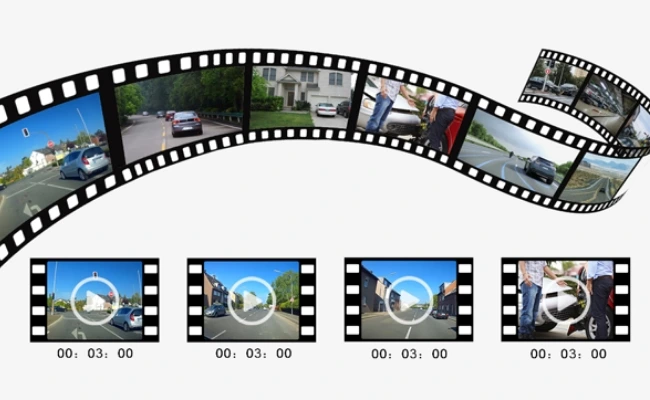
A continuous recording security camera is one that works all the time. It records everything it sees, 24/7. This is different from motion sensor cameras, which start recording only when they spot movement. Continuous recording security cameras never take a break, ensuring nothing gets missed. You get a full video record without any missing pieces.
Key Benefits of Continuous Recording
Complete Coverage: These cameras give you a full record of everything that happens. This is very important for places that need high security, like banks, casinos, or other key locations.
You Won’t Miss Anything: These cameras don’t depend on motion sensors, which means you don’t risk missing key events because of a technical problem.
Live Monitoring: Because the camera is always recording, the security team can watch the live feed at any moment. This helps them react to problems as they happen.
What is a Motion Sensor Camera?
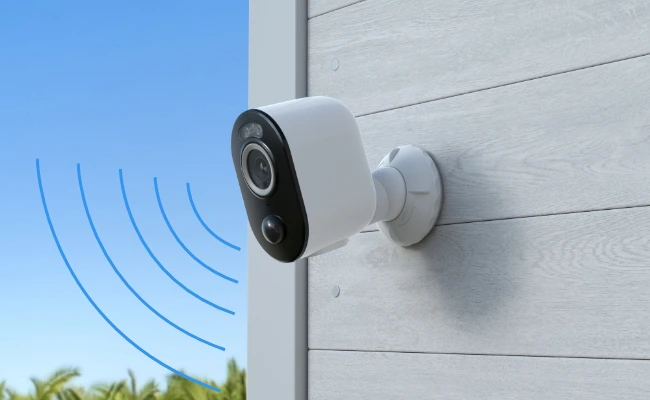
A motion sensor security camera is a smart device that records video just when it spots movement in its line of sight. They use motion detection to know when to start recording. Most models use passive infrared (PIR) sensors to detect body heat from people or animals. Some newer models use software to see changes in the picture. Others might use microwave or ultrasonic sensors to find movement.
Key Benefits of Motion Sensor Cameras
Storage and Power Savings: Motion sensor cameras only record videos when they detected movements, which can save storage space and power. This means you use less power and save money on data storage and your electric bill.
Immediate Alerts: The system sends you an alert right away when it sees motion. You get a notification on your phone or an email. This lets you or your security team respond fast to a potential break-in.
Focused Footage: The recorded footage is meaningful, so you don’t have to watch hours of empty videos. This makes it much easier to review events.
Continuous Recording Security Camera vs Motion Sensor Camera: Key Differences, Pros & Cons
1. Recording Mechanism and Functionality: How They Work
This is the core difference between these two camera types. Understanding their recording engines is key to choosing the right one for your needs.
Continuous Recording Security Cameras: The Unblinking Eye
Think of these cameras as a relentless, 24/7 eyewitness. Their primary function is to document everything, without exception.
24/7 Non-Stop Recording: They capture footage every second of every day, ensuring no event—expected or unexpected—is missed due to a lack of motion.
Complete Coverage, Zero Gaps: This uninterrupted recording provides a perfect, unbroken timeline of activity. This is invaluable for forensic review, as you can scroll through any point in time.
Loop Recording for Efficiency: To manage storage, most cameras use a method called “loop recording.” Once the storage (like an SD card or hard drive) is full, it automatically overwrites the oldest footage, creating a continuous, seamless cycle.
Advanced Playback & Search: You can review footage by precisely searching for a specific time, date, and camera. Key features include a time and date stamp on every frame for legal accuracy and smooth live viewing.
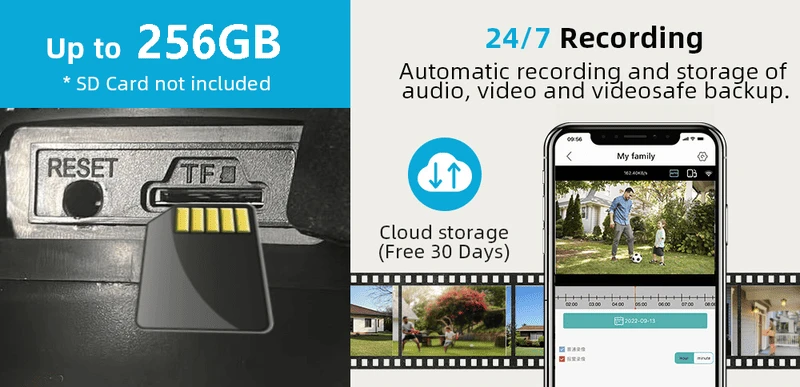
Storage & Cost: Many models support continuous local recording to an SD card at no ongoing cost, eliminating the need for a mandatory paid cloud subscription.
Motion Sensor Cameras: The Efficient Sentinel
These cameras are designed to be efficient and alert-driven. They sleep until their “trigger” is pulled, saving power and storage.
Record-on-Trigger Operation: They only start recording when their sensor (typically a PIR heat sensor or software analyzing pixels for movement) detects activity.
Focused on Events, Not Footage: This means your storage is filled only with potentially important clips, making it much easier to find and review specific events without sifting through hours of empty footage.
The Pre-Roll Buffer (A Critical Feature): To avoid missing the start of an action, good motion cameras have a pre-alarm buffer. They secretly save 2-5 seconds before the motion is even triggered, so you see the lead-up to the event.
Storage Efficiency: By eliminating footage of empty hallways or still landscapes, these cameras have dramatically lower storage requirements than their continuous counterparts.
Potential for Missed Moments: The trade-off is that subtle movements or activity outside the sensor’s range or sensitivity settings might not trigger a recording, potentially causing gaps.
2. Storage Requirements: A Tale of Volume vs. Efficiency
Storage is also one of the most significant practical differences between the two systems. Your choice will directly impact your hardware costs and how you manage your footage.
Continuous Recording Security Cameras: The Data Giants
Continuous cameras are voracious consumers of storage space. They prioritize complete coverage over efficiency, requiring robust hardware to support their 24/7 operation.
High Daily Data Consumption: A single 1080p camera can easily generate 40–60GB of data per day. This adds up quickly; a standard 4-camera system needs 2–4TB of storage to retain just one month of footage.
Resolution is a Major Factor: Higher resolutions exponentially increase storage needs. A single 4K camera can consume over 50GB per day. Scaling this to an 8-camera 4K system would require adding multiple terabytes of storage every single week.
Retention Periods Dictate Capacity: How long you need to keep footage (30, 60, or 90 days) is the primary driver for how much storage you must buy. Businesses often need large-capacity systems to meet compliance or investigative needs.
Compression Technology is Key: The video codec makes a huge difference. Modern H.265 compression can cut storage needs in half compared to the older H.264 standard, without sacrificing video quality. Always check which codec a camera uses.
Relies on Robust Hardware: This method necessitates a capable NVR/DVR with large-capacity hard drives or a paid cloud subscription service designed for massive, ongoing data uploads.
Motion Sensor Cameras: The Storage Savers
Motion-activated cameras are designed for efficiency. By only recording when necessary, they dramatically reduce the burden on your storage infrastructure.
Massive Storage Reduction: By eliminating hours of footage with no activity, these systems can reduce storage usage by 60–80% or more compared to continuous recording.
Usage Varies by Environment: The actual storage savings depend on how often motion is triggered. A camera in a busy hallway will record more than one monitoring a rarely visited basement. On average, you might only be recording 10-50% of the total day.
Practical Example: A 16-camera system that would need ~9.6TB for continuous recording might only require ~4.8TB for two weeks if motion is detected 50% of the time. This effectively doubles your storage retention without spending more.
Enables Smaller, Cheaper Solutions: This efficiency allows for practical use of local storage like SD cards and more affordable cloud plans, as you are only uploading short, event-based clips.

3. Power Consumption and Bandwidth: The Hidden Costs
Beyond the camera’s price tag, its ongoing operational impact on your electricity bill and internet network is a crucial deciding factor. This is where the two types diverge dramatically.
Continuous Recording Security Cameras: The Always-On Appliance
These cameras operate like any other constant electronic device, drawing a steady stream of power and data around the clock.
- Constant Power Draw: A wired continuous camera typically consumes between 4 to 10 watts per hour. While a single camera’s draw seems small, it never stops. For example, a 5-watt camera running 24/7 uses about 3.6 kWh per month, costing roughly $0.47 per month per camera (at average U.S. electricity rates).
- Steady, High Bandwidth Usage: This is the bigger consideration for most users. Continuous recording means a non-stop upload of data. A single HD camera can use a constant 1-5 Mbps of your internet bandwidth. Multiple cameras can quickly saturate a home network, potentially slowing down other activities like streaming, gaming, or video calls.
- Impact of Features: Higher resolutions (4K), higher frame rates, and features like always-on night vision incrementally increase both power and bandwidth demands.
- Network Strain: This constant upload is a significant burden on your internet connection, especially if you are using a cloud-based storage system. It requires a robust and unlimited data plan from your Internet Service Provider (ISP).
Motion Sensor Cameras: The Energy-Sipping Sentinel
Motion-activated cameras are designed for efficiency, conserving resources until they are needed to perform their primary function.
- Significantly Lower Power Use: These cameras, especially wireless models, are incredibly efficient. They often draw a minimal 2-6 watts only when active and spend most of their time in a low-power “standby” mode. This efficiency is why battery-powered models are feasible, often lasting months on a single charge.
- Intermittent, Bursty Bandwidth: Instead of a constant trickle of data, these cameras only use bandwidth in short bursts when motion is detected. This can reduce total data transfer by 70-90% compared to a continuous camera. Your home network remains free and clear until an event occurs.
- Ideal for Limited Setups: This efficient model enables completely wireless and solar-powered setups, offering true installation flexibility without needing nearby power outlets. The minimal bandwidth usage also makes them perfect for locations with slower internet connections or metered data plans.
Quick Comparison: Power & Bandwidth
Consideration | Continuous Recording Camera | Motion Sensor Camera |
Power Profile | Constant, predictable draw | Intermittent, low standby draw |
Monthly Power Cost (est.) | ~$0.50 per camera | Pennies per camera |
Bandwidth Profile | Constant, heavy upload | Bursty, minimal upload |
Data Usage | High (1-5 Mbps constant per cam) | Low (70-90% reduction) |
Network Impact | Can congest home internet | Minimal to no impact |
4. Reliability: Continuous Recording Security Cameras vs Motion Sensor Cameras
When we talk about reliability in security cameras, we need to define what we’re relying on them to do. Is it to capture everything without fail, or to alert you efficiently to specific events?
Continuous Recording Security Cameras: The Unblinking Eye
These cameras are fundamentally more reliable for one primary goal: guaranteed coverage.
Strength: Captures Every Moment. Because they record 24/7, they do not rely on sensors or algorithms to decide what is important. This makes them exceptionally reliable for capturing subtle events, slow-moving activity, or incidents that occur just outside a motion sensor’s range. There is zero risk of missing an event due to a failed trigger.
Weakness: Dependent on Hardware and Storage. Their reliability is tied to the integrity of their supporting systems. If the power fails, the storage fills up, or the NVR/DVR encounters a hardware fault, recording will stop, creating a gap. Proper setup with battery backups and adequate storage is essential.
Motion Sensor Cameras: The Finicky Guard
These cameras are reliable for conserving resources and providing alerts, but less so for providing a complete historical record.
Weakness: Potential for Missed Events and False Alerts.
Their reliability is entirely dependent on the motion sensor’s accuracy. Motion sensor cameras can fail to record (a “false negative”) if:
- Motion is too slow or too far away.
- The sensor is poorly calibrated or obstructed.
- Environmental factors like heavy rain, fog, or glaring headlights interfere.
They can also be triggered when they shouldn’t be (a “false positive”), such as by moving shadows, pets, or foliage, which can lead to alert fatigue.
Strength: Reliability in Power-Dependent Scenarios. For wireless or battery-powered setups, motion sensors are more reliable. By not draining power on continuous recording, they ensure the camera remains operational for much longer, making them a reliable choice for locations without easy access to power.
For maximum reliability of evidence and complete peace of mind that nothing was missed, a continuous recording camera is superior. For a more convenient, resource-efficient system where you accept a small risk of missed activity in exchange for alerts and long battery life, a motion sensor camera can be reliable enough.
5. Applications: Continuous Recording Security Camera vs Motion Sensor Camera
Choose A Continuous Recording Security Camera when you cannot afford to miss a single second.
- High-Security Commercial Spaces: Banks, casinos, jewelry stores, and museums use them to document every single person and event, providing irrefutable evidence for investigations.
- Busy Retail & Hospitality: In retail stores, hotels, and restaurants, they help with liability claims (like slip-and-falls), internal theft prevention, and managing customer interactions by providing a full context of any incident.
- Critical Infrastructure & Warehouses: Monitoring server rooms, construction sites, and warehouse perimeters where any activity, no matter how small or slow-moving, could be significant.
- Compliance & Legal Environments: Ideal for situations requiring strict accountability, such as police body cameras or childcare centers, where a continuous record is necessary for legal protection.
Choose Motion Sensor cameras for smart alerts, resource efficiency, and monitoring specific events in typically quiet areas.
- Residential Homes: The top choice for home security. They conserve battery (for wireless models) and storage while sending instant alerts to your phone when someone approaches your door or yard.
- Low-Traffic Areas: Perfect for monitoring vacation homes, basements, garages, or offices after hours. There’s no need to record empty rooms for 20 hours a day.
- Smart Home Integration: They work seamlessly with smart systems, triggering smart lights or alarms when motion is detected, creating an active deterrent.
- Wildlife Monitoring & Outdoor Spaces: Excellent for capturing specific events like package deliveries, wildlife visits, or vehicles entering a driveway without being filled with hours of irrelevant footage.
In summary, the choice between continuous recording security camera and motion sensor camera boils down to your specific needs. Continuous recording offers full-time, reliable surveillance, leaving no moment unrecorded, but at the cost of higher storage and power consumption. Conversely, motion sensor recording is an efficient and affordable solution that conserves resources by focusing on key events, making it ideal for the vast majority of everyday home and business users.
Your final decision should hinge on your environment, security requirements, and budget.
Still unsure which camera type is perfect for you? As a leading security camera manufacturer in China, we are here to help. Contact our experts today for a personalized purchasing solution tailored to your property.