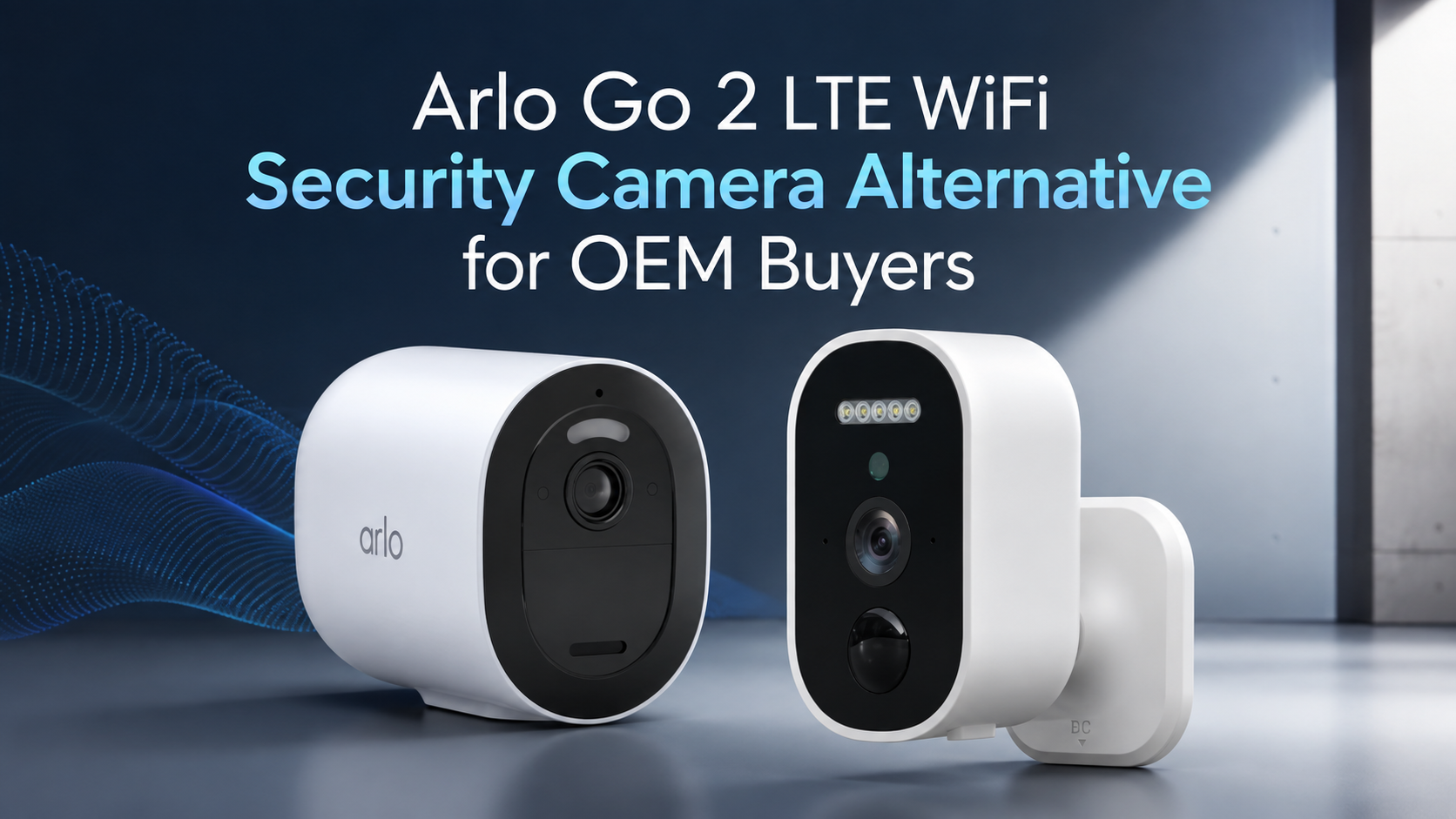
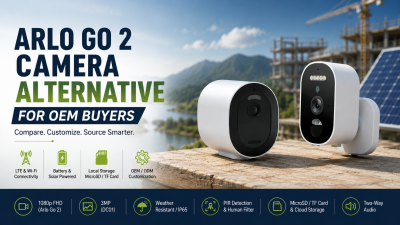
Buyers searching for an Arlo Go 2 LTE WiFi Security Camera usually need an outdoor camera that can continue operating beyond a conventional home or office network. Farms, construction sites, cabins, equipment yards, marinas, temporary retail locations, and remote entrances may require LTE connectivity, battery power, local storage, and simple wire-free installation.
The official reference product in this article is the Arlo Go 2 LTE/Wi-Fi Security Camera, model VML2030. It is a finished retail camera with documented LTE and 2.4GHz Wi-Fi connectivity, Wi-Fi-to-LTE backup, 1920 × 1080 video, built-in GPS, direct MicroSD storage, a removable rechargeable battery, an integrated spotlight, and two-way audio.
DC01 represents a different sourcing direction. It is a compact 3MP Tuya battery camera with PIR human filtering, TF card storage, Type-C charging, full-duplex audio, IP65 protection, and a 3.5W solar configuration. Although an optional 4G upgrade is mentioned in the supplied information, standard DC01 should not be presented as a confirmed LTE camera until its cellular hardware and regional compatibility have been validated.

What Is the Arlo Go 2 LTE WiFi Security Camera?
The Arlo Go 2 LTE WiFi Security Camera referenced throughout this guide is model VML2030. It is a full-HD, wire-free outdoor security camera that can connect through LTE, directly through 2.4GHz Wi-Fi, or through Wi-Fi with LTE serving as a backup connection.
Its documented maximum resolution is 1920 × 1080 using H.264. The camera provides a 130-degree diagonal field of view, 12× digital zoom, an integrated spotlight, Color Night Vision, and 850nm infrared illumination up to approximately 25 feet or 7.6 meters.
Other documented features include two-way noise-canceling audio, a built-in microphone and speaker, a siren, outdoor GPS camera location, direct MicroSD storage, a removable rechargeable lithium-polymer battery, solar-panel compatibility, and wire-free mounting.
Arlo describes the camera as weather-resistant rather than assigning it a published IP65 or IP66 rating. Its documented operating range is -20°C to 45°C. The unit measures approximately 85.85 × 64.26 × 119.89mm and weighs approximately 409g.
Why Buyers Search for an Arlo Go 2 LTE WiFi Security Camera Alternative
The Arlo Go 2 LTE WiFi Security Camera is supplied as a completed branded product with a predefined housing, app, cellular workflow, battery, firmware, accessories, storage process, packaging, and service ecosystem. This structure can suit end users who want an established product, but OEM buyers frequently need different commercial and technical conditions.
A distributor may need to define the target country, LTE bands, carrier, SIM format, app platform, resolution, battery configuration, solar accessory, local storage, packaging, quantity, certifications, and target landed cost. Some buyers also require a Tuya-based product that fits an existing smart-home range.
Cellular and Wi-Fi versions may require different modules, antennas, firmware, power management, test procedures, certifications, and quotations. A product described simply as “4G upgradeable” is therefore not automatically ready for an LTE deployment.
The purpose of evaluating an alternative is not to suggest that Arlo lacks value. It is to identify the product architecture that best matches the buyer’s market, sales channel, service model, and supply-chain requirements.
Why the Arlo Go 2 LTE/Wi-Fi Security Camera Appeals to Remote Buyers
The main advantage of the Arlo Go 2 is its flexible connection architecture. It can operate through LTE where fixed broadband is unavailable, use 2.4GHz Wi-Fi at a home or business, or maintain LTE as a backup when Wi-Fi internet access becomes temporarily unavailable.
This makes it relevant to farms, cabins, marinas, large properties, construction areas, equipment yards, popup retail sites, RV monitoring, and other locations where a permanent router connection cannot always be guaranteed.
The camera also combines GPS camera location, direct MicroSD storage, a removable rechargeable battery, compatible solar charging, two-way audio, a spotlight, Color Night Vision, and an integrated siren. Buyers who prefer a finished retail ecosystem may value this combination more than the additional sourcing control available through an OEM project.
Who Should Still Choose the Arlo Go 2 LTE WiFi Security Camera?
The original product may remain the more suitable choice when proven LTE operation and an established consumer platform are more important than private-label sourcing flexibility.
Projects requiring documented LTE Cat 4 connectivity
Sites needing 2.4GHz Wi-Fi with LTE backup
Users who require an established SIM and carrier workflow
Applications benefiting from built-in outdoor GPS camera location
Buyers requiring direct MicroSD local storage
Users wanting a removable rechargeable battery
Projects requiring an integrated spotlight, Color Night Vision, and siren
Existing Arlo customers who prefer one app and accessory ecosystem
Buyers who accept applicable mobile-data and cloud-service costs
DC01 should not replace the Arlo model in a specification when verified LTE operation is mandatory, but the proposed DC01 cellular version has not completed testing.

Arlo Go 2 LTE WiFi Security Camera Connectivity and Failover
The Arlo Go 2 LTE WiFi Security Camera supports three practical connection modes: LTE only, 2.4GHz Wi-Fi only, or Wi-Fi with LTE backup.
When Wi-Fi is configured and available, the camera normally prioritizes the Wi-Fi network. If internet access through that network becomes temporarily unavailable, the camera can use its LTE connection. Once Wi-Fi service returns, the camera reconnects to Wi-Fi.
Buyers using the camera in an LTE-only location can disable Wi-Fi searching in the app. This prevents the camera from repeatedly trying to find a previously configured network, which can affect battery life.
Arlo documents a 2.4GHz wireless range of up to approximately 300 feet or 91 meters under line-of-sight conditions. Walls, metal, building materials, interference, router position, and installation height can reduce real range. The documented network requirement is at least 2Mbps upload and download speed per camera.
VML2030 should not be described as supporting 5GHz Wi-Fi, Ethernet, PoE, 5G, dual-SIM, or eSIM unless separate model-specific documentation confirms those functions.
SIM Cards, LTE Bands, and Carrier Planning
LTE operation requires an activated SIM card, a compatible mobile-data plan, sufficient network coverage, and a camera version that supports the target carrier and region. Without an activated SIM, Arlo Go 2 can still be set up in Wi-Fi mode.
Arlo documents an LTE Cat 4 modem. The listed bands for the referenced version include:
4G LTE: B2, B4, B5, B12, B14, B66, and B71
Legacy 3G: B2, B4, and B5
These band details should not automatically be applied to every regional unit. Buyers should confirm the exact target-country version, carrier, LTE bands, SIM size, APN requirements, roaming policy, carrier approval, and network technology schedule before ordering.
Current US documentation lists AT&T, Cellcom, T-Mobile, U.S. Cellular, and Verizon Wireless as supported service providers. Provider availability can differ by country and may change, so it should be reconfirmed during procurement.
Mobile Data Use for an LTE WiFi Security Camera Project
Arlo provides a monthly cellular-data reference of approximately 700MB to 2GB for the Arlo Go 2 LTE WiFi Security Camera. Actual use depends on the number of motion events and the length of recordings.
Data consumption can also change with live viewing, two-way audio, user activity, video settings, and firmware behavior. A quiet rural gate and a high-traffic construction entrance will not produce the same mobile-data requirement.
OEM buyers should model data use around the intended deployment rather than using a universal carrier plan. A useful test includes quiet, average-activity, and high-activity environments with the same recording and notification settings intended for the final product.
LTE service and cloud recording are separate commercial considerations. A future DC01 cellular configuration must be tested independently because standard Wi-Fi sample results cannot confirm LTE data consumption.
Arlo Go 2 LTE WiFi Security Camera Video, Night Vision, and Audio
The Arlo Go 2 LTE WiFi Security Camera has a documented maximum video output of 1920 × 1080 using H.264. It provides a 130-degree diagonal field of view and 12× digital zoom.
Digital zoom enlarges an existing part of the image rather than adding optical detail. Useful results still depend on the original footage, lighting, subject movement, compression, mounting angle, and distance.
Night monitoring combines an 850nm infrared LED, an integrated spotlight, and Color Night Vision. The infrared illumination reference is up to approximately 25 feet or 7.6 meters. This distance describes illumination coverage and is not a guaranteed facial- or license-plate-identification range.
Arlo Go 2 also includes a microphone and speaker for full-duplex two-way conversation. The integrated siren can support deterrence, but its exact sound-pressure level should not be added without official model-specific documentation.
DC01 is specified as 3MP and uses an SC2336 sensor with a 3.6mm F2.8 lens. Its stated field of view is 120 degrees. The exact output dimensions, aspect ratio, codec, frame rate, bitrate, and field-of-view measurement direction require confirmation.

Arlo Go 2 LTE WiFi Security Camera Battery and Solar Planning
Arlo Go 2 uses an extra-large removable rechargeable lithium-polymer battery. Current official battery guidance lists approximately six months of operation under average-use assumptions.
Average use assumes optimized power settings and less than three minutes of recording per day. Actual battery life can vary with mobile signal strength, motion frequency, clip duration, live viewing, spotlight operation, two-way audio, temperature, and repeated network reconnection.
Compatible accessories include an extra rechargeable battery, a dual-battery charging station, magnetic charging cables, outdoor charging accessories, and compatible solar-panel chargers. Solar performance depends on sunlight duration, panel orientation, shading, temperature, camera activity, and cellular signal quality.
DC01 uses two 18650 lithium cells with a stated combined battery-pack capacity of 5200mAh. The supplied information lists Type-C charging in approximately eight hours, a 3.5W solar configuration, and a 25–30-day standby reference.
The DC01 standby figure should not be treated as confirmed active runtime. Actual operation must be tested under the intended event frequency, recording duration, live view, audio, Wi-Fi or LTE connection, night mode, and temperature.
Arlo Go 2 LTE WiFi Security Camera Local Storage and Cloud Options
The Arlo Go 2 LTE WiFi Security Camera includes a MicroSD card slot inside the camera housing. Supported card types include SD, SDHC UHS-I, and SDXC UHS-I cards with Class 10, U1, or U3 performance and capacities up to 2TB.
According to the current Arlo storage workflow, MicroSD recording is used when the camera is not connected to the cloud. Local recording must be enabled in the Arlo Secure App.
To view the stored files, the user safely ejects the card through the app, removes it from the camera, and opens the recordings on a computer. By default, the oldest recordings are overwritten when the card becomes full, although automatic overwrite can be disabled.
Arlo states that this local-storage process is not a complete standalone replacement for cloud recording. Cloud services, trial periods, recording retention, and plan features can vary by country, retailer, and date.
DC01 supports TF cards up to 128GB and selected Tuya cloud storage. Its recording triggers, overwrite rules, encryption, offline recording, playback, downloads, account sharing, and cloud-retention terms should be verified on the approved firmware.
GPS, Spotlight, Siren, and Remote-Site Functions
Built-in outdoor GPS can help a user locate an Arlo Go 2 camera installed in a remote area. It should not automatically be described as a real-time vehicle tracker, route-history device, or geofencing system.
The spotlight can be activated manually or configured to trigger when motion is detected. It supports color nighttime footage and also provides visible illumination around the camera.
The speaker supports both two-way audio and the integrated siren. The camera housing is described as weather-resistant and is designed for indoor or outdoor use within the documented operating range.
DC01 does not currently have confirmed GPS or a confirmed siren. These functions should not be added to a sales page, quotation, or comparison table without product documentation.
Can DC01 Work as an Arlo Go 2 LTE WiFi Security Camera Alternative?
DC01 can be evaluated as an Arlo Go 2 LTE WiFi Security Camera alternative for projects that prioritize 3MP imaging, Tuya, PIR human filtering, TF card storage, Type-C charging, full-duplex audio, and solar support.
Its supplied hardware configuration includes an Ingenic T23X processor, SC2336 sensor, 3.6mm F2.8 lens, and a stated 120-degree field of view. Detection combines PIR sensing with human-shape filtering and an effective reference of approximately ten meters.
DC01 also supports TF cards up to 128GB, selected cloud storage, IP65 protection, Alexa, Google Assistant, and two-way full-duplex audio. Its supplied night-monitoring direction includes 850nm infrared and white light with an approximately ten-meter illumination range.
However, standard DC01 is not automatically a verified LTE camera. The optional 4G direction requires separate confirmation of the cellular module, supported bands, SIM format, APN workflow, antenna, app behavior, carrier compatibility, certification, power consumption, and price.
Bluetooth provisioning and the final dual-light configuration should also be confirmed for the exact quoted version. DC01 is therefore an alternative sourcing platform rather than a feature-for-feature Arlo replica.

Arlo Go 2 LTE WiFi Security Camera vs DC01: Core Product Differences
Comparison Item | Arlo Go 2 VML2030 | DC01 |
|---|---|---|
Product Position | Finished LTE/Wi-Fi retail camera | Compact Tuya battery-camera sourcing model |
Video Specification | 1920 × 1080 | 3MP; exact dimensions unconfirmed |
Video Format | H.264 | Unconfirmed |
Field of View | 130° diagonal | Stated 120°; direction unconfirmed |
Digital Zoom | 12× | Unconfirmed |
Connectivity | LTE and 2.4GHz Wi-Fi | Tuya connectivity; Wi-Fi band unconfirmed |
LTE Status | Documented LTE Cat 4 workflow | Optional 4G direction requires validation |
SIM and Carrier | Activated SIM and compatible plan required for LTE | SIM, APN, bands, and carriers unconfirmed |
Wi-Fi Backup | LTE can back up Wi-Fi | LTE/Wi-Fi failover unconfirmed |
GPS | Built-in outdoor GPS camera location | Not confirmed |
Night Monitoring | 850nm IR, spotlight, Color Night Vision | 850nm IR and white-light direction |
Audio | Two-way noise-canceling audio | Full-duplex two-way audio |
Siren | Integrated | Not confirmed |
Local Storage | MicroSD up to 2TB | TF card up to 128GB |
Battery | Removable rechargeable lithium-polymer battery | 2 × 18650, stated 5200mAh pack |
Battery Reference | Approximately six months under average use | Approximately 25–30 days standby |
Charging and Solar | Magnetic charging and compatible solar accessories | Type-C and 3.5W solar configuration |
Outdoor Description | Weather-resistant | IP65 |
Smart Home | Alexa, Google Assistant, and IFTTT | Alexa and Google Assistant |
Unit Size | 85.85 × 64.26 × 119.89mm | 85 × 145 × 74mm |
Unit Weight | Approximately 409g | Approximately 380g |
Price Basis | Retail pricing varies | USD 13.24–17.65 factory reference |
The Arlo Go 2 LTE WiFi Security Camera is the stronger documented fit when LTE, Wi-Fi backup, GPS, MicroSD storage, and an established carrier workflow are mandatory. DC01 serves a different sourcing tier and should only be positioned for cellular projects after the proposed 4G version has been validated.
DC01 4G Upgrade Requirements for LTE Camera Projects
The phrase “4G upgradeable” is not a complete product specification. Before DC01 is offered as an LTE camera, the supplier should confirm:
Cellular-module manufacturer and model
LTE category and supported frequency bands
SIM format and physical SIM access
APN setup and supported carriers
Antenna design and installation position
Tuya or alternative app workflow
Wi-Fi and LTE connection priorities
Network-loss and reconnection behavior
TF card operation during network loss
Cellular data consumption
LTE battery consumption and standby behavior
Compatibility with the 3.5W solar configuration
Radio, EMC, battery, and regional telecom requirements
Final 4G price, MOQ, warranty, and production lead time
The USD 13.24–17.65 reference should not be assumed to include the cellular module, antenna, SIM components, firmware work, certification, or additional power-management changes.
Is 3MP Enough for an Arlo Go 2 LTE WiFi Security Camera Alternative?
Arlo Go 2 has a documented output of 1920 × 1080. DC01 is specified as 3MP, but its exact output dimensions have not been supplied.
A higher nominal megapixel number does not automatically guarantee better image quality. Practical performance also depends on sensor response, lens quality, exposure, frame rate, bitrate, codec, lighting, motion, network conditions, and mounting position.
Arlo’s 1080p output may suit remote event verification, equipment checks, temporary locations, and general site monitoring. A 3MP product may suit buyers seeking a different resolution tier, a Tuya-based product line, or closer monitoring of entrances, yards, and gates.
Buyers should compare original daytime, infrared, white-light, Wi-Fi, and proposed LTE sample footage recorded in the same scene. Facial- or plate-identification distances should not be published until supported by defined tests.

DC01 Specifications for Arlo Go 2 LTE WiFi Security Camera Projects
DC01 Item | Supplied Specification | Sourcing Note |
|---|---|---|
Model | DC01 | Mini battery camera; regular-stock direction |
Housing | Plastic | Final finish and color require confirmation |
Resolution | 3MP | Exact output dimensions unconfirmed |
App | Tuya | Cloud and regional service terms require confirmation |
Processor | Ingenic T23X | Verify against approved production sample |
Sensor | SC2336 | Verify against approved production sample |
Lens | 3.6mm, F2.8 | Stated field of view: 120° |
Detection | PIR + human filtering | Approximately 10m reference |
Night Monitoring | 850nm IR + white-light direction | Final dual-light implementation requires confirmation |
Night Illumination | Approximately 10m reference | Not a guaranteed identification distance |
Storage | TF card up to 128GB + cloud | Recording workflow requires verification |
Audio | Full-duplex two-way audio | Test delay, echo, volume, and wind noise |
Battery | 2 × 18650, stated 5200mAh pack | Cell details and active runtime unconfirmed |
Standby Reference | Approximately 25–30 days | Not equivalent to active operating runtime |
Charging | Type-C, approximately 8 hours | Charging conditions require confirmation |
Solar | 3.5W configuration | Included panel and accessories require quotation confirmation |
Protection | IP65 | Request test evidence where required |
Smart Home | Alexa and Google Assistant | Confirm supported commands and target regions |
Optional Directions | Bluetooth, 4G, and dual-light upgrade | Confirm the exact quoted version |
Unit Size | 85 × 145 × 74mm | Supplied product data |
Unit Weight | Approximately 0.38kg | Supplied product data |
Master Carton | 49.5 × 39.1 × 30.8cm | 30 units per carton |
Carton Weight | Approximately 17.5kg | Supplied logistics data |
Factory Reference Price | USD 13.24–17.65 | Final configuration may change pricing |
OEM Cost Planning for an Arlo Go 2 LTE WiFi Security Camera Alternative
Arlo retail pricing and the DC01 factory reference represent different stages of the supply chain. They should not be compared as equivalent landed costs or used to calculate an automatic saving percentage, resale price, gross margin, or three-year ownership advantage.
A complete Arlo Go 2 LTE WiFi Security Camera alternative budget may include:
Camera hardware, battery pack, bracket, cable, and solar panel
Cellular module, antenna, SIM holder, and RF components
TF card and cloud-storage services
Tuya platform fees and firmware support
SIM management and mobile-data plans
Packaging, labels, manuals, and barcodes
Samples, inspection, reliability testing, and approved-sample control
Radio, EMC, battery, safety, and environmental compliance
Freight, duty, warehousing, warranty stock, returns, and support
Logo printing, customized packaging, app options, firmware changes, certification support, MOQ, payment terms, warranty, and lead time require a formal quotation.
Relevant internal resources may include Security Camera Manufacturer, OEM Security Camera Manufacturer, 4G Security Camera, Solar Security Camera, Private Label Security Camera, and CCTV Camera Wholesale.
How to Test an Arlo Go 2 LTE WiFi Security Camera Alternative
Testing should use the exact DC01 Wi-Fi or cellular configuration intended for mass production. The approved sample should contain the same processor, sensor, lens, battery, wireless module, antenna, firmware, app, housing, mount, solar panel, and accessories planned for the order.
Confirm actual output dimensions, aspect ratio, frame rate, bitrate, codec, and field of view.
Test Tuya onboarding, reset, Bluetooth provisioning if included, and Wi-Fi reconnection.
For cellular samples, verify SIM activation, APN setup, LTE bands, carrier access, and network recovery.
Measure cellular data use under quiet, average, and high-activity conditions.
Review daytime, infrared, and white-light footage in the intended installation scene.
Test PIR response, human filtering, side approaches, and environmental false alerts.
Verify full-duplex audio, notification delay, speaker volume, microphone clarity, echo, and wind noise.
Test 32GB, 64GB, and 128GB TF card recognition and formatting.
Verify event recording, playback, overwrite, timestamps, and network-loss behavior.
Measure battery use separately under Wi-Fi and LTE operation.
Test Type-C and solar charging under the intended climate and mounting direction.
Inspect IP65 assembly, seals, charging port, bracket, carton, and included accessories.
Pass-or-fail limits should be defined in a signed product specification after sample evaluation. The approved sample should then be frozen as the production-inspection baseline.

FAQ About Arlo Go 2 LTE WiFi Security Camera Alternatives
Do you sell the Arlo Go 2 LTE WiFi Security Camera?
No. We are not affiliated with Arlo and do not sell Arlo-branded products.
Which Arlo Go 2 model is referenced?
This article references the Arlo Go 2 LTE/Wi-Fi Security Camera, model VML2030.
Does Arlo Go 2 support both LTE and Wi-Fi?
Yes. It supports LTE, direct 2.4GHz Wi-Fi, or Wi-Fi with LTE serving as a backup connection.
Can Arlo Go 2 automatically use LTE when Wi-Fi fails?
Yes. When both are configured, LTE can be used if Wi-Fi internet access becomes temporarily unavailable, and the camera can return to Wi-Fi when service is restored.
Does Arlo Go 2 require a SIM card?
An activated SIM and compatible mobile-data plan are required for LTE operation. Wi-Fi-only setup is possible without an activated SIM.
Does Arlo Go 2 support LTE Advanced or 5G?
It uses an LTE Cat 4 modem and does not operate at LTE Advanced speeds. The current specification does not list 5G .
How much cellular data does Arlo Go 2 use?
Arlo provides a reference of approximately 700MB to 2GB per month, depending mainly on motion activity and recording duration.
What is the resolution of the Arlo Go 2 LTE WiFi Security Camera?
Its documented maximum output is 1920 × 1080 using H.264.
Does Arlo Go 2 support local MicroSD storage?
Yes. It accepts compatible MicroSD cards up to 2TB for its documented local-recording workflow.
Does the Arlo Go 2 have GPS?
Yes. It includes outdoor GPS camera location to help users locate a camera installed in a remote area.
Is the Arlo Go 2 battery removable?
Yes. It uses a removable rechargeable lithium-polymer battery.
Can Arlo Go 2 use a solar panel?
Yes. It is compatible with applicable Arlo solar-panel chargers.
Is standard DC01 a confirmed LTE camera?
No. Optional 4G connectivity is mentioned, but the cellular module, bands, SIM workflow, app, certification, power use, and price require separate confirmation.
What is the confirmed resolution of DC01?
DC01 is specified as 3MP. Its exact output dimensions require confirmation.
Does DC01 support local TF card storage?
Yes. It supports TF cards up to 128GB, along with selected cloud storage.
Does DC01 support solar charging?
The supplied information lists a 3.5W solar configuration. The panel, cable, mount, and included accessories should be confirmed in the quotation.
Can DC01 be supplied for OEM projects?
OEM requirements can be discussed, but logo, packaging, app options, firmware, 4G functions, certifications, MOQ, warranty, and lead time require formal confirmation.
Source the Right Arlo Go 2 LTE WiFi Security Camera Alternative
Arlo Go 2 VML2030 is a documented 1080p wire-free security camera with LTE, 2.4GHz Wi-Fi, cellular backup, GPS, MicroSD storage, a removable battery, a spotlight, Color Night Vision, a siren, and compatible solar accessories.
Standard DC01 serves a different sourcing tier with 3MP imaging, Tuya, PIR human filtering, TF card storage, full-duplex audio, Type-C charging, IP65 protection, and a 3.5W solar configuration.
The appropriate Arlo Go 2 LTE WiFi Security Camera alternative depends on the target country, carrier, LTE bands, app platform, storage workflow, battery requirements, solar configuration, quantity, certifications, and landed-cost target.
DC01 should only be positioned as a cellular alternative after the proposed 4G module, SIM workflow, supported bands, app behavior, data consumption, power use, and regional compliance have been validated.
Send Your Reference Model & Get Similar Camera Options
Share your target country, carrier, LTE bands, quantity, resolution, app, storage, battery, solar, packaging, and compliance requirements.
Request OEM Price, MOQ, Samples, and Available 4G Configurations