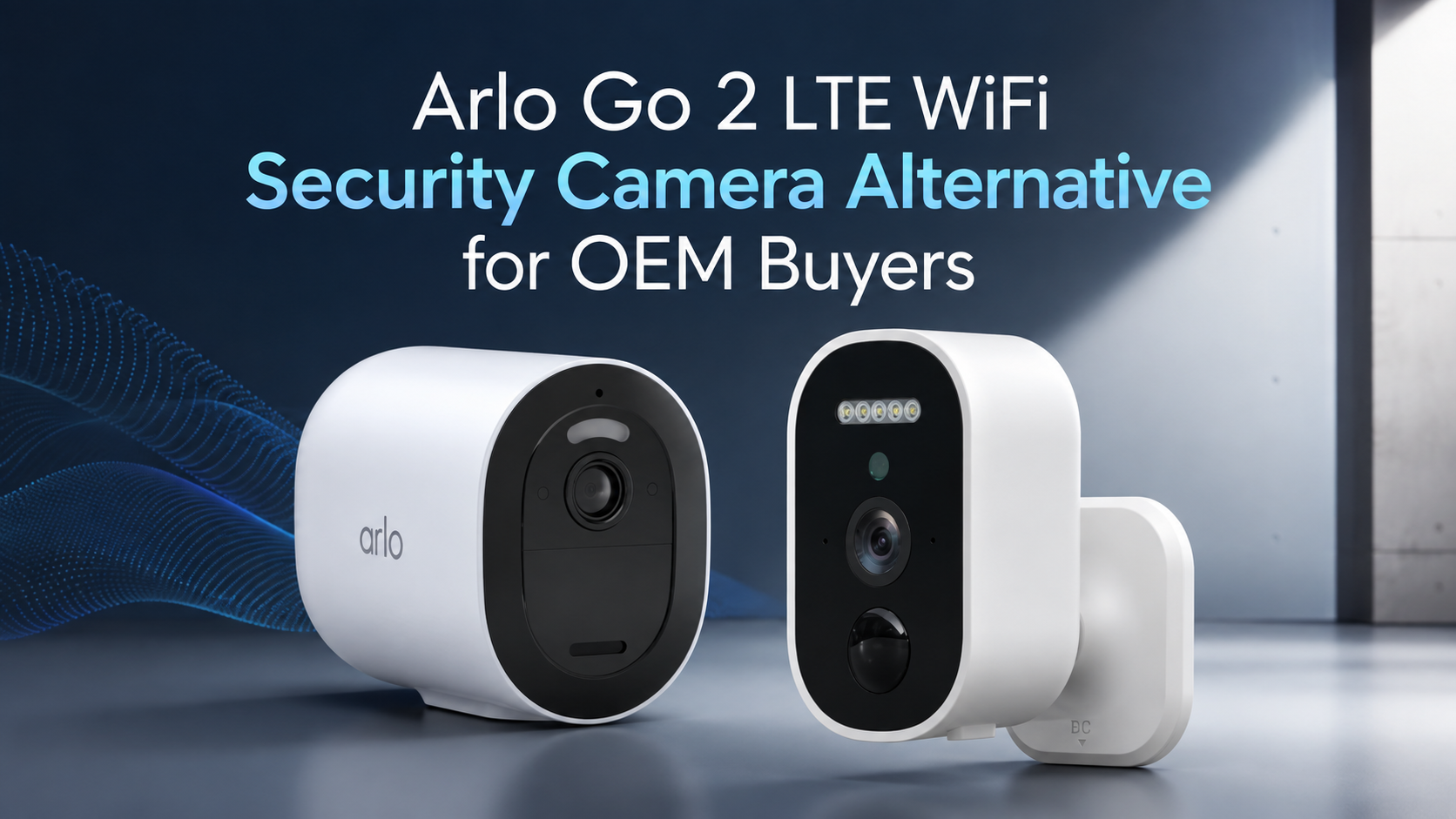
Buyers searching for an Arlo LTE Camera usually need outdoor monitoring where fixed broadband is unavailable or unreliable. In this guide, the term refers to the Arlo Go 2 LTE/Wi-Fi Security Camera, model VML2030. It is a finished retail product with documented LTE and 2.4GHz Wi-Fi connectivity, 1080p video, GPS camera location, onboard microSD storage, a removable battery, a spotlight, and an established app ecosystem.
The alternative discussed is DC01, a compact 3MP Tuya battery camera with PIR detection, human-shape filtering, TF card storage, Type-C charging, solar support, full-duplex audio, and IP65 protection. The supplied information lists a 4G upgrade, but the standard DC01 specification does not define the cellular module, LTE bands, SIM workflow, carrier compatibility, GPS, or network-switching behavior.
What Is the Arlo LTE Camera?
The official reference product is the Arlo Go 2 LTE/Wi-Fi Security Camera, model VML2030. It can connect through LTE, connect directly to 2.4GHz Wi-Fi, or use LTE as a backup when a configured Wi-Fi internet connection becomes unavailable.
The camera records at up to 1920 × 1080 using H.264. It has a 130-degree diagonal field of view, 12× digital zoom, an integrated spotlight, color night vision, and one 850nm infrared LED with a stated illumination distance of up to approximately 25 feet.
Other confirmed functions include two-way audio, GPS camera location, direct microSD recording, a removable rechargeable battery, solar compatibility, and weather-resistant construction. Arlo lists an operating range of -20°C to 45°C.

Why the Arlo LTE Camera Appeals to Remote-Site Buyers
The main value of the Arlo LTE Camera is network flexibility. It can monitor cabins, farms, large properties, marinas, recreational vehicles, temporary retail sites, and job sites without depending entirely on a nearby router.
When LTE and Wi-Fi are both configured, Arlo Go 2 normally prioritizes Wi-Fi. If Wi-Fi internet access is interrupted, the camera can switch to LTE and later return to Wi-Fi. Users can also disable Wi-Fi when they want mobile-network-only operation.
GPS can help locate the camera, while the removable battery, microSD slot, spotlight, siren, and two-way audio support remote-site maintenance and active monitoring. LTE still requires an activated SIM, a compatible plan, sufficient signal, and a supported regional version.
Who Should Still Choose the Arlo Go 2 LTE Camera?
Arlo Go 2 may remain the better fit for customers who want a completed product rather than an OEM development project.
Existing Arlo users who want one account and notification system
Buyers requiring documented LTE, 2.4GHz Wi-Fi, and backup behavior
Remote sites that benefit from GPS camera location
Users who prefer a removable rechargeable battery
Buyers who want a confirmed 130-degree view, spotlight, siren, and microSD slot
Users working with supported Alexa, Google Assistant, or IFTTT services
Why OEM Buyers Search for an Arlo LTE Camera Alternative
Arlo Go 2 is supplied with predefined housing, app, cloud services, firmware, LTE bands, battery, packaging, and accessories. OEM buyers may instead need a camera structured around their destination market, mobile operators, sales channel, and product range.
A cellular-camera project normally requires decisions about LTE bands, modem, SIM format, APN setup, roaming, antenna, data-plan management, network recovery, app onboarding, storage, battery, solar accessories, labels, packaging, and certifications.
The goal is a verified Arlo LTE Camera alternative that can be quoted, carrier-tested, supported, and reordered with stable hardware and firmware.
Arlo LTE Camera Connectivity, SIM, and Data-Plan Considerations
Arlo Go 2 uses an LTE Cat 4 modem. Its documented 4G bands are 2, 4, 5, 12, 14, 66, and 71. An activated SIM and mobile data plan are required for LTE operation.
Arlo lists selected providers by country, including AT&T, Cellcom, T-Mobile, U.S. Cellular, and Verizon Wireless in the United States. Supported bands do not guarantee compatibility with every SIM, MVNO, or roaming plan.
Arlo estimates approximately 700MB to 2GB of cellular data per month, depending mainly on motion triggers and recording length. Buyers should test the final camera using their expected event volume, live-view behavior, clip duration, firmware, and carrier.
Arlo recommends at least three bars of mobile signal. At two bars or below, live view, uploads, and notifications may become less reliable, while repeated reconnection attempts can shorten battery life.
A DC01 4G quotation should therefore identify the modem, LTE category, bands, antenna, SIM format, APN workflow, carrier testing, Wi-Fi availability, and network priority rather than using only a general “4G supported” description.

Can DC01 Work as an Arlo LTE Camera Alternative?
DC01 may support an Arlo LTE Camera alternative project if an approved 4G configuration is defined, quoted, sampled, and verified. The standard supplied DC01 should not be presented as a completed LTE camera.
The standard platform uses an Ingenic T23X chipset and SC2336 sensor. It is specified as a 3MP Tuya camera with a 3.6mm F2.8 lens and a stated 120-degree field of view. Exact output dimensions, aspect ratio, frame rate, bitrate, codec, and field-of-view measurement direction require confirmation.
DC01 combines PIR sensing with human-shape filtering and has a stated detection reference of approximately ten meters. The supplied information also lists 850nm infrared and white-light modes, with approximately ten meters of effective illumination.
It supports TF cards up to 128GB, selected Tuya cloud storage, full-duplex audio, IP65, Google Assistant, and Alexa. It uses two 18650 cells with a stated 5200mAh pack, Type-C charging, and a 3.5W solar configuration.
Before DC01 is marketed as an LTE product, buyers must confirm the cellular module, bands, SIM workflow, app behavior, power consumption, certifications, price, lead time, and production status.
Arlo LTE Camera vs DC01: Core Product Differences
Comparison Item | Arlo Go 2 VML2030 | DC01 |
|---|---|---|
Product Position | Finished LTE/Wi-Fi retail camera | Tuya battery sourcing model |
Standard LTE | Confirmed LTE Cat 4 | Not confirmed |
LTE Bands | B2/B4/B5/B12/B14/B66/B71 | Not confirmed |
SIM | Activated SIM and data plan required | Workflow not confirmed |
Wi-Fi | 2.4GHz | Bands not confirmed |
LTE Backup | Confirmed with Wi-Fi configured | Not confirmed |
GPS | Outdoor GPS camera location | Not confirmed |
Resolution | 1920 × 1080 | 3MP; output dimensions not confirmed |
Field of View | 130° diagonal | Stated 120°; direction not specified |
Detection | Motion alerts with eligible Arlo services | PIR with human-shape filtering |
Night Monitoring | 850nm IR, spotlight, color night vision | 850nm IR and white-light modes |
Night Distance | Up to approximately 25ft | Approximately 10m reference |
Siren | Integrated | Not confirmed |
Local Storage | microSD, eligible cards up to 2TB | TF card up to 128GB |
Battery | Removable 3.63V, 13000mAh, 47.19Wh | Two 18650 cells, stated 5200mAh |
Battery Reference | About six months with average use | 25–30 days standby reference |
Charging | Magnetic charging | Type-C, about eight hours |
Solar | Compatible accessories | 3.5W configuration |
Outdoor Description | Weather-resistant | IP65 |
Price Basis | Retail product | USD 13.24–17.65 factory reference |
Arlo Go 2 is the more documented cellular product. DC01 is a sourcing candidate whose 4G version requires full technical definition. Retail and factory-reference prices are not equivalent.

Arlo LTE Camera Battery, Charging, and Solar Considerations
The Arlo LTE Camera uses a removable 3.63V, 13000mAh, 47.19Wh lithium-polymer battery. Arlo gives an average-use reference of approximately six months and notes that cellular runtime varies with signal strength.
Cold temperatures, low light, frequent spotlight use, long recordings, weak Wi-Fi, and weak cellular signal can reduce battery life. The removable design allows a charged spare battery to be installed during a maintenance visit.
DC01 uses two 18650 cells with a stated 5200mAh pack, an approximately eight-hour Type-C charging reference, and a 3.5W solar configuration. Its stated standby reference is approximately 25–30 days.
DC01’s 4G runtime is not confirmed. The modem, signal quality, event uploads, live viewing, and white-light use may change its power profile. Solar support may reduce charging frequency but does not guarantee uninterrupted operation.
Arlo LTE Camera Detection and Night Vision
False alerts affect battery, data use, storage, cloud traffic, and user experience. Arlo Go 2 combines motion alerts with a spotlight, color night vision, and 850nm infrared illumination up to approximately 25 feet. Selected smart classifications may depend on the applicable Arlo Secure service.
DC01 uses PIR detection with human-shape filtering and a stated range of approximately ten meters. Its supplied specification does not confirm vehicle, animal, package, facial, or license-plate classification.
Buyers should test approach angles, mounting heights, vegetation, pets, vehicles, headlights, rain, and insects. A 4G version should also be tested under strong, medium, and weak signals to measure notification delay, upload time, battery use, and data consumption.
Arlo LTE Camera App, Local Storage, and Data Costs
The Arlo LTE Camera uses the Arlo Secure App for setup, connection selection, live view, notifications, GPS location, storage settings, and account management.
Arlo Go 2 supports Arlo Secure cloud storage and direct microSD recording. Eligible Class 10, U1, or U3 cards are supported up to 2TB. Local storage does not remove SIM data costs because remote live view, notifications, account communication, and cloud functions still use the network.
DC01 uses Tuya, supports TF cards up to 128GB, and lists cloud storage through the selected Tuya configuration. Card formatting, overwrite, offline recording, in-app playback, downloads, and cloud retention should be verified on the final sample.
A cellular DC01 may require different hardware, firmware, Tuya onboarding, and cloud services. Adding a modem does not automatically preserve every Wi-Fi-version function.

DC01 Specifications for Arlo LTE Camera Alternative Projects
DC01 Item | Supplied Data | Project Note |
|---|---|---|
Model | DC01 | Regular-stock standard model |
Housing | Plastic | |
Resolution | 3MP | Exact output requires confirmation |
App | Tuya | 4G workflow not confirmed |
Core Hardware | T23X + SC2336 | Verify against production sample |
Lens | 3.6mm, F2.8 | Stated FOV 120° |
Detection | PIR + human filtering | Approximately 10m reference |
Night Modes | 850nm IR + white light | Final dual-light setup required |
Battery | 2 × 18650, stated 5200mAh | Cell details not confirmed |
Charging | Type-C, about eight hours | Conditions not defined |
Solar | 3.5W configuration | Inclusion and interface not confirmed |
Storage | TF up to 128GB + cloud | Playback and overwrite require testing |
Audio | Full-duplex two-way | Test delay and echo |
Protection | IP65 | Request supporting documentation |
Smart Home | Alexa + Google Assistant | Verify commands and regions |
Bluetooth | Mentioned as included/upgradeable | Confirm quoted version |
4G | Upgrade direction listed | Module, bands, SIM, and app required |
Unit | 85 × 145 × 74mm; 0.38kg | Supplied logistics data |
Carton | 30 units; 49.5 × 39.1 × 30.8cm; 17.5kg | Supplied logistics data |
Reference Price | USD 13.24–17.65 | Do not assume 4G or solar is included |
OEM Cost and Project Planning for an Arlo LTE Camera Alternative
Arlo retail pricing and the DC01 factory reference represent different supply-chain stages. An Arlo LTE Camera alternative budget should include hardware, modem, antenna, SIM holder, battery, solar panel, accessories, Tuya services, cloud storage, SIM activation, mobile data, packaging, testing, certification, freight, duty, warranty stock, returns, and support.
The USD 13.24–17.65 reference should not be assumed to include 4G hardware, solar, customized packaging, certification, or logistics. MOQ, cellular-version pricing, warranty, lead time, and production status require a formal quotation.
Start the project with the destination country, intended operators, LTE bands, network model, SIM workflow, app, storage, battery, solar package, quantity, packaging, compliance needs, and target price.
Relevant internal resources may include Security Camera Manufacturer, OEM Security Camera Manufacturer, Private Label Security Camera, 4G Security Camera, and CCTV Camera Wholesale.
How to Test an LTE Security Camera Before Bulk Ordering
A standard Wi-Fi DC01 sample cannot validate a future 4G version. The test unit must use the intended modem, antenna, firmware, Tuya configuration, battery, solar panel, and accessories.
Confirm the SoC, sensor, lens, battery, modem, antenna, and firmware.
Match LTE bands to the intended operators and test real SIM cards.
Test activation, APN setup, network registration, and recovery after signal loss.
Measure alert delay, live-view startup, reconnection, and cellular data use.
Test strong, medium, and weak signal conditions.
Review daylight, infrared, and white-light footage.
Test PIR detection, human filtering, and environmental false alerts.
Verify TF recording, playback, overwrite, and timestamps.
Measure battery use during events, live view, and weak-signal operation.
Evaluate solar charging in the intended climate and mounting direction.
Freeze the approved sample and create a signed specification covering the modem, bands, firmware, sensor, lens, battery, antenna, accessories, and packaging. Use it as the production-inspection baseline.

FAQ About Arlo LTE Camera Alternatives
Do you sell the Arlo LTE Camera?
No. We are not affiliated with Arlo and do not sell Arlo-branded products.
Which Arlo LTE Camera is referenced?
Arlo Go 2 LTE/Wi-Fi Security Camera, model VML2030.
Does Arlo Go 2 support LTE and Wi-Fi?
Yes. It supports LTE and 2.4GHz Wi-Fi, with LTE available as a backup to a configured Wi-Fi connection.
Does Arlo Go 2 require a SIM card?
An activated SIM and data plan are required for LTE operation. Wi-Fi setup is also available.
Which LTE bands does Arlo Go 2 support?
The documented bands are 2, 4, 5, 12, 14, 66, and 71. Regional and carrier compatibility should still be checked.
How much cellular data does Arlo Go 2 use?
Arlo estimates approximately 700MB to 2GB per month, depending mainly on motion triggers and recording length.
Does Arlo Go 2 support local storage?
Yes. It has a built-in microSD slot and supports eligible cards up to 2TB.
Is the standard DC01 an LTE camera?
No confirmed LTE implementation is provided for the standard version. A 4G upgrade is listed.
Can DC01 be upgraded for 4G?
A 4G option is listed, but the module, bands, SIM workflow, app, battery performance, certification, price, and lead time require confirmation.
Does DC01 support automatic LTE and Wi-Fi switching?
This function is not confirmed and should not be advertised without testing.
Does DC01 include GPS?
GPS is not confirmed.
Can DC01 use solar charging?
A 3.5W solar configuration is listed. Panel inclusion, connector, cable, accessories, and price require confirmation.
Can DC01 be supplied for OEM projects?
OEM requirements can be discussed, but logo, packaging, app, firmware, certification, MOQ, warranty, and lead time require project confirmation.
Source the Right Arlo LTE Camera Alternative for Your Market
The Arlo LTE Camera remains a useful reference for documented LTE Cat 4, 2.4GHz Wi-Fi, cellular backup, GPS, a removable battery, microSD storage, a spotlight, color night vision, and an established app ecosystem.
DC01 offers a different confirmed platform based on 3MP imaging, Tuya, PIR human filtering, TF storage, Type-C charging, full-duplex audio, IP65 protection, and solar support. It should not be marketed as an identical Arlo Go 2 replacement.
Its suitability as an Arlo LTE Camera alternative depends on the final modem, LTE bands, SIM workflow, carrier tests, app configuration, power use, certifications, and production quotation.
Send Your Target LTE Bands & Get Similar Cellular Camera Options
Share your Arlo LTE Camera reference, country, intended operators, required bands, quantity, SIM workflow, app, storage, battery, solar, packaging, target price, and certifications.